
Famous Freemasons (A – Z) – THE END
Q
Quezon y Molina, Manuel Luis (1878-1944) – Quezon was the first President of the Commonwealth of the Philippines (1935-1944) under U.S. occupation rule in the early period of the 20th century. Manuel Quezon was raised on 17 March 1908 in Sinukuan Lodge No.272 (renamed Sinukuan Lodge No.16) and became the first Filipino Grand Master of the Grand Lodge of the Philippine Islands that was established in 1917.
R
Raffles, Sir Thomas Stamford Bindley (1781-1826) – A British statesman and the Freemason best known as “The Father of Singapore”, Thomas Raffles was also heavily involved in the conquest of the Indonesian island of Java from Dutch and French military forces during the Napoleonic Wars and contributed to the expansion of the British Empire. He was raised on 5 July 1813 into Lodge De Vriendschap, Sourabaya.

Alf Ramsey oversaw the victory of the England football team in the 1966 World Cup.
Ramsey, Sir Alfred Ernest ‘Alf’ (1920-1999) – In his early career, Alf Ramsey was a star player for Tottenham Hotspur and was capped for England 32 times (1948-1954). In 1963 he took over as manager of England, guiding the team to their historic 1966 World Cup 4-2 win against Germany. He was initiated into Waltham Abbey Lodge No.2750, Hertfordshire, England on the 5 October 1953 at the age of 33. Following his passing to The Grand Lodge Above in 1999, his widow, Lady Vickie Ramsey, donated his regalia to his Lodge and this is currently on display at the Masonic Hall in Chingford, Essex.

Rašín, Dr. Alois (1867-1923) – Czech Republic economist and resistance fighter, who helped to form Czechoslovakia, the first act of Czech law is in his handwriting. In 1923 Rašín was murdered; shot in the back by an anarchist, Josef Soupal.
Reid, Sir George Houstoun (1845-1918) – The 4th Prime Minister of Australia, George Reid was born in Renfrewshire, Scotland. He was more effective as Premier of New South Wales (NSW) (1894-1899) than as Prime Minister of Australia (1904-1905). Reid was a member of Lodge Centennial No.169, United Grand Lodge of NSW.
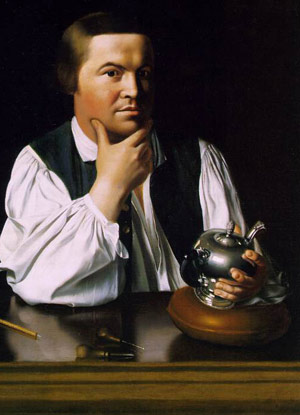
Paul Revere was a silversmith, early industrialist, and a famous patriot of the American Revolution.
Revere, Paul (1735-1818) – A silversmith, engraver and American Revolutionary hero, on April 18, 1775 Paul Revere made the epic horse ride, warning the American militia in Concord and Lexington about the advance of British Regular soldiers. The event was celebrated in a poem by Longfellow with its famous warning, “The British are coming!” Less dramatically however Revere, with quiet secrecy, actually warned the American Revolutionaries, “The ‘Regulars’ are coming out” [of their Boston barracks]. Revere was heavily involved with the Lodge of St. Andrews and Grand Master of the Grand Lodge of Massachusetts. He was also a friend of Freemasons James Otis and Joseph Warren Jr. (See below.)
Revie, Donald George ‘Don’ (1927-1989) – Having successfully played for several soccer clubs including Manchester City (1951-56), and managed Leeds United (1961- 1974) with whom he won the F.A. Cup in 1972 and the European Cup in 1973, Don Revie became the manager of the England football team between 1974 and 1977. Revie had been initiated into Leodiensis Lodge No.4029, in 1965.
Rhodes, Cecil John (1853-1902) – Rhodes was an English-born businessman, mining magnate, and politician in South Africa. He was the founder of the diamond company De Beers, which today markets 40% of the world’s rough diamonds. At one time, how- ever, De Beers marketed 90%. An ardent believer in colonialism and imperialism, he was the founder of the state of Rhodesia; named after him. After independence, Rhodesia separated into the nations of Northern and Southern Rhodesia, later renamed Zambia and Zimbabwe, respectively, but neither state has prospered as well since. South Africa’s Rhodes University is named after him and he set up the provisions of the ‘Rhodes Scholarship’; funded by his estate. He remained a Freemason until his death in 1902.
Rhodes, Elisha Hunt (1842-1917) – Anyone who has seen U.S. filmmaker Ken Burns’ epic PBS production ‘The Civil War’, will be familiar with the name of Elisha Hunt Rhodes as Brother Rhodes’ war diary was one of the chief sources quoted throughout. In it, as a member of the Union Army of the Potomac, he speaks of an incident at Gettysburg where he witnessed Union soldiers retrieve the body of a ‘Rebel’ and pro- vide a proper burial as they had determined that the Confederate was a brother Freemason. Rhodes states that he did not understand these actions but within a year, he joined ‘The Craft’ while on leave in Rhode Island and, such was his dedication that he rose through Masonic ranks to become Grand Master of the Grand Lodge of Rhode Island (1892-1893).
Richet, Charles Robert (1850-1935) – A French physician, physiologist and metaphysician, Charles Richet was the co-discoverer of the medical phenomenon which he named anaphylaxis and, in 1913, received the Nobel Prize for physiology. His research also helped elucidate the phenomenon of hay fever, asthma and several other allergic reactions. Richet belonged to Lodge Cosmos under the Grand Lodge of France.
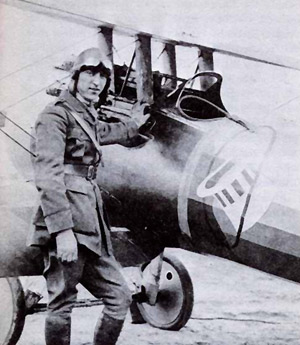
Eddie Rickenbacker was an American World War I fighter ace, a recipient of the Medal of Honor, and a pioneer in commercial aviation.
Rickenbacker, Edward Vernon ‘Eddie’ (1890-1973) – A World War I fighter ace and winner of the Medal of Honor, Eddie Rickenbacker became a pioneer in air transportation, he eventually served as president of Eastern Air Lines. Rickenbacker was a Mason in Kilwinning Lodge No. 297, Michigan.
Riley, Charles Owen Leaver (1854-1929) Born in Birmingham, England, Charles Riley was a dedicated clergyman and became the first Anglican Archbishop of Perth, Western Australia. Riley was also an enthusiastic Freemason, becoming the longest serving Grand Master of the District Grand Lodge of Western Australia between 1904 to 1917 and again from 1920 to 1929. Sir William Ellison-Macartney (see above) covered a three year gap (1917-1920), partly caused by Riley’s service during The Great War.
Ringling Brothers – This famous circus family benefited Freemasonry with the mem- bership of all of its seven sons, and even their father too! Five of the Ringling Brothers started the Ringling Brothers Circus in 1870 with two other brothers, Henry and Augustus joining later. At one time, John Nicholas Ringling had become one of the richest men in the world, with property in Florida and a large collection of art, but the Great Depression (1929-1939) robbed him of most of his fortune. This gathering of famous Ringling brethren was:
Albert Charles ‘Al’ Ringling (1852–1916);
Augustus Gustav ‘Gus’ Ringling, Jr. (1854–1907) (Joined the circus in 1889.);
William Henry Otto ‘Otto’ Ringling (1858–1911);
Alfred Theodore ‘Alf’ Ringling (1861–1919);
Charles Edward ‘Charley’ Ringling (1863–1926);
John Nicholas Ringling (1866–1936) and
Henry William George Ringling (1868–1918). (Joined the Brothers’ circus in 1886.)
Their father, Heinrich Friedrich August Ringling (1826-1898), was from Hanover, Germany and was also a Freemason. All seven brothers and their father, August Ringling, were members of Baraboo Lodge No. 34, Baraboo, Wisconsin.
Roberts VC, Sir Frederick Sleigh ‘Bobs’ – Field Marshall, The Right Honourable, 1st Earl Roberts of Kandahar (1832-1914) – Bobs Roberts was a distinguished British soldier who regarded himself as Anglo-Irish, yet he was actually born in India. Having already won the Victoria Cross (VC) in 1858, during the Indian Rebellion, Roberts was one of the most successful commanders of the Victorian era, capturing Kabul from the Afghan emir, whose forces he finally defeated at the ‘Battle of Kandahar’ in 1880. Roberts also commanded the British Army during the Second Boer War, relieving Kimberly in 1899 and advancing on Pretoria. (Remarkably, Roberts’ son also won a VC during the Boer War but, following the action, died of his wounds.) Bobs Roberts himself died while visiting Indian troops in France during World War I.
Robinson, ‘Sugar Ray’ (Real name: Walker Smith Jr.) (1921-1989) – Sugar Ray Robinson was a celebrated American boxer who became a World Champion six times – once as a welterweight and five times as a middleweight. He won or drew 179 of his 200 professional fights. Robinson belonged to Joppa Lodge No. 55 in New York City.
Rogers, Roy (Real name: Leonard Franklin Slye) (1911-1998) – Dubbed “King of the Cowboys”, Roy Rogers was the typical ‘all-American’ actor and singer who played a singing cowboy in Western films. Always wearing a white hat, Rogers played the hero who never killed his opponent but rather would shoot him in the hand to disable him. Roy Rogers was a member of Hollywood Lodge No.355, California, and has proudly displayed on his Masonically inscribed gravestone, the Cross of his faith and his 33rd Degree Masonic emblem.
Rogers, William Penn Adair ‘Will’ (1879-1935) – Will Rogers was an actor, comedian, columnist and radio personality, noted for his wry, homespun commentary on society and politics. Rogers, a master horseman, was also immensely skilled with a lasso, so-much-so that he made it into the Guinness Book of Records for accurately throwing three whirling lassos all at once. He championed the expanse of air connection within the U.S.A. but was ironically killed, along with his friend and pioneer aviator, Wiley Post, in a take-off accident in Alaska in 1935. Rogers attended Claremore Lodge No.53 in Oklahoma.
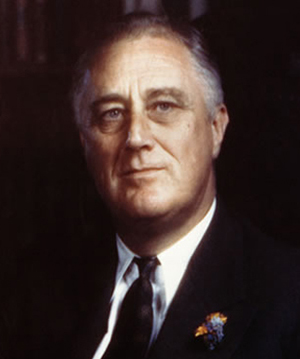
So effective was he as a leader that Franklin D. Roosevelt is the only U.S. President to be elected for four terms in office.
Roosevelt, Franklin Delano (1882-1945) – 32nd President of the United States, Franklin D. Roosevelt was the only president to be re-elected four times. Also known as ‘FDR’, he brought his country out of the Great Depression, guided them through World War II but, by early 1945, he was a very sick man. He died on April 12, just 18 days before his by then defeated enemy, Adolf Hitler. Referring to his guidance prior to, and during, the Second World War ‘The New York Times’ newspaper declared, “Men will thank God on their knees a hundred years from now that Franklin D. Roosevelt was in the White House”. He was initiated into Freemasonry on 11th October 1911 as a member of Holland Lodge No.8, New York City. FDR became a Shriner in 1930. Franklin D. Roosevelt was succeeded as President in 1945 by another Freemason, Harry S. Truman (see below).
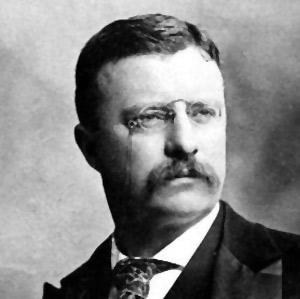
Theodore Roosevelt said he was “half Irish and half Dutch.” As a diplomat, he was characterized by the famous slogan, ‘Speak softly and carry a big stick.’
Roosevelt, Theodore (1858-1919) – 26th President of the U.S.A., Theodore Roosevelt was a hero of the Spanish-American War and an energetic leader with a wide range of interests. He had a ‘cowboy’ image of robust masculinity that he probably fostered to cloud the fact that he did not enjoy perfect health – especially as a child. When, in 1901, President William McKinley (see above) was assassinated, Theodore Roosevelt became the new U.S. president. In 1906, he also won the Nobel Peace Prize. Freemason, Franklin D. Roosevelt (see above), the outstanding President of pre-WWII and wartime America, was Theodore’s 5th cousin, though Theodore was more closely related to Franklin’s wife, Eleanor, who was his niece. Theodore Roosevelt was very supportive of Freemasonry and was a member of Matinecock Lodge No.806, Oyster Bay, New York.
Ros, Edmundo (1910-2011) – Edmundo Ros was born on the 7 December 1910 in Port of Spain, Trinidad. Following service with the army and playing the euphonium in an army band, Ros went on to become a renowned musician, vocalist and band leader, active from 1939 to 1975. While on tour in 1975, he dissolved his orchestra when Musician’s Union representatives went behind his back while arranging booking fees. A man of honour, Ros felt so insulted and let down that he never reformed the band. In 2000, at the age of 90, Ros was awarded the OBE in the New Year’s Honours List. He passed to The Grand Lodge Above on 21 October 2011 aged 100. Edmundo Ros was a member of the Sprig of Acacia Lodge No. 41, Jávea, Spain.
Rose, Sir Alec (1908-1991) – Born in Canterbury, England, Alec Rose was a horticultural nursery owner and fruit merchant, certainly an unlikely background from which to become a single-handed, round the world yachtsman. In 1968, however, Rose was knighted by Queen Elizabeth II, for doing just that, circumnavigating the world single-handed in 354 days in the yacht ‘Lively Lady’.
de Rothschild, James Mayer (Born: Jakob Mayer Rothschild) (1792-1868) – Born in Frankfurt-am-Main, Germany on 15 May 1792, James de Rothschild was the fifth son and youngest child of Mayer Amschel Rothschild (1744-1812). Mayer sent each of his five sons to a prominent European commercial centre in order to found branches of the family banking empire; de Rothschild therefore moved to Paris in 1811 and in 1817 expanded the family banking empire to the city, opening de Rothschild Frères. An advisor to two kings of France, he became the most powerful banker in the country and following the Napoleonic Wars, played a major role in financing the construction of railroads and the mining business that helped make France an industrial power. Along the way, he added to his fortune with investments in such things as the importation of tea and the purchase of a vineyard (Château Lafite Rothschild). A strong-willed and shrewd businessman, James de Rothschild amassed a fortune that probably made him the richest man in the world. The family’s wealth was so astounding as to be hard to believe. It is estimated that in today’s money, James de Rothschild’s personal fortune (not including the wealth of his other family members) was alone at least five times the fortune accumulated by Bill Gates. Rothschild was initiated on 24 October 1802 into Emulation Lodge No.12, London.
Rowan, Archibald Hamilton (1751-1834) – Although born in London, Archibald Rowan was an Irish celebrity and founding member of the Dublin Society of United Irishmen. Rowan was a champion of the poor and underprivileged, but his radical views got him imprisoned. He escaped and fled to France, where he met Robespierre, and was caught up in the French Revolution. Next he fled to America, and was then caught up in the American Revolution. Following petitioning by his wife, Rowan was pardoned in 1803 and lived to old age – unlike many of his revolutionary associates.
Rudolph, Donald Eugene (1921-2006) – During the war in the Pacific, Don Rudolph received a Medal of Honor (the U.S.A.’s highest award for military gallantry) for heroic action during action on Luzon in the Philippines. On 5th February 1945, armed with a rifle and grenades, he first cleared a trench of enemy soldiers pinning down his section. In steady sequence he then neutralized, eight enemy machine gun posts and finally destroyed a Japanese tank that threatened his men. He was promoted to Second Lieutenant in the field and later wounded by shrapnel. Rudolph was an active member of Minnesota Chapter No. 25 National Sojourners, until just before his death in May, 2006.
Rusk, John W. – American patriot, John Rusk gained national prominence portraying ‘Uncle Sam’, as a regular fixture in any event involving Washington DC, dressed in his striped pants, top hat and stilts.
S
Salten, Felix (Given name: Seigmund Salzmann) (1869-1945) – Born in Budapest, Salten lived for much of his life in Austria, writing for many Viennese publications. In 1923, as a story for adults, he created the character of the fawn ‘Bambi’. In 1936 the Nazis banned and burned the book as being pro-Jewish propaganda. The rights to the children’s version were fought over for many years after Salten’s death.
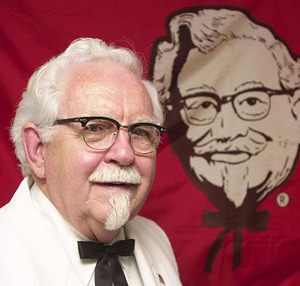
The founder of the KFC food chain, ‘Colonel’ Harland Sandersestablished a foundation which aids charities with more than a million dollars in grants each year.
Sanders, Harland David ‘Colonel’ (1890-1980) – ‘Colonel’ Harland Sanders’ Kentucky Fried Chicken (KFC) outlets are found world-wide. He perfected his “original recipe of 11 secret herbs and spices” in 1939. Sanders was also the mentor of fellow Freemason Dave Thomas (see below), of Wendy’s restaurants fame. When he died in 1980, his body laid in state in the Rotunda of the Kentucky State Capital.
San Martin, Jose de (Given name: Jose Francisco de San Martin Gomez y Matorras) (1778-1850) – San Martin was an Argentine General and the prime leader of the southern part of South America’s successful struggle for independence from Spain. At the early age of seven he left Argentina and studied in an aristocratic school in Madrid, Spain, where he met and befriended Chilean freedom fighter Bernardo O’Higgins (see above). In 1808, he fought with Spanish forces in the Peninsular War against the French, and then returned to Argentina to fight for its independence from Spain. Following a “this town ain’t big enough for the two of us” type disagreement with Simón Bolívar (see above) San Martin left the country and its politics and did not return.
Santa Anna, López de (Given name: Antonio de Padua María Severino López de Santa Anna y Pérez de Lebrón) (1794-1876) – Most well known as Santa Anna, the Mexican General who so brutally defeated the ‘Texian’ defenders at the ‘Siege of the Alamo’ on 6 March 1836, he was a Mexican political leader, General, and president who greatly influenced early Mexican and Spanish politics and government. Santa Anna first fought against the independence from Spain, and then supported it. He was not the first Caudillo (military leader) of Mexico, but he was among the most original. He rose to the ranks of General and president at various times over a turbulent 40 year career. He was President of Mexico on eleven non-consecutive occasions over a period of 22 years.
Sarnoff, David (1891-1971) – This Russian-born broadcasting executive did much to promote broadcasting around the world. In America Sarnoff started as an office work- er with Marconi Wireless Telegraph Company, later absorbed by the Radio Corporation of America (RCA). Rising to the top ranks of RCA, he organized the National Broadcasting Company (NBC) as part of RCA, and NBC became the first permanent broadcasting network. It was Sarnoff who first envisioned “broadcasting”, that is, radio for the masses, not individual to individual. He did the same with television, which he also helped to pioneer.

Who loves ya, baby. Telly Savalas was a gifted actor and proud Freemason.
Photo: Copyright © www.tellysavalas.com
Savalas, Aristotelis ‘Telly’ (1922-1994) – Telly Savalas was a charismatic actor who became most famous as the bald, lollypop sucking, police detective, Kojak, who was tough on the outside but gentle inside. Savalas starred in numerous films including ‘The Dirty Dozen’ (1967) with Lee Marvin and ‘Kelly’s Heroes’ (1970) with Clint Eastwood. His brother, George Savalas (1924-1985), was also an actor and Freemason.
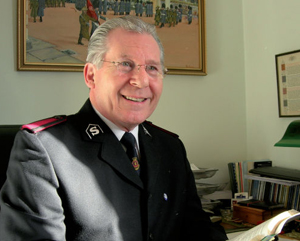
David Sawyer a committed member of the Salvation Army and a Freemason.
Sawyer, David (1940 – ) A committed member of the Salvation Army, David Sawyer was born on 19 February 1940 in York. He later became a full-time Minister and served as a Pastoral Minister in South Wales, Kent and Berkshire. David was appointed to the headquarters of the Salvation Army Men’s Social Work Department in 1965 and served at their international headquarters before returning to the Men’s Social Services for a further period after being appointed as the Private Secretary and Personal Assistant to the Director of Social Services for Great Britain and Ireland.
Sawyer became Education Officer with Buckinghamshire County Council and Head of the Education Welfare Service in Milton Keynes. Taking early retirement in 1992, he worked for a period time with the Independent Counselling and Advisory Service and later set up a chain of four charity shops for the Salvation Army. Somehow David also managed to fit in joining Milton Keynes General Hospital as a Care Manager.
In 1981 David Sawyer was initiated into the Lodge of Integrity No. 5149 in Chelmsford, Essex, England and rose to become Provincial Grand Chaplin in 2006. He was also exalted in Oliver Chapter No. 2812.
Schaefer, Julius Earl (1893-1978) – Julius Schaefer founded the Wichita company that later became the Boeing Aircraft Corporation’s Wichita plant. He oversaw production of large volumes of aircraft during the Second World War, including 10,000 plus Boeing Kaydet trainers, and 1,165 Boeing B-29 Superfortress’, the same type of bomber that dropped the atomic bombs on Japan and which brought World War Two to an end. Schaefer also moved into the jet-age by overseeing the production of the multi-engined, Boeing B-52 Stratofortress, an aeroplane capable of carrying a huge bomb load, and which is still in service today.
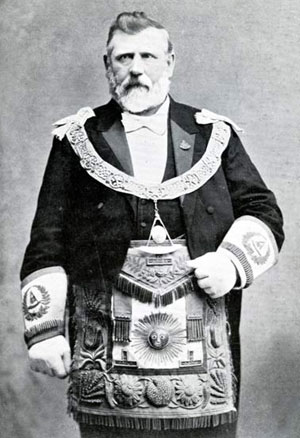
Seddon was born in Eccleston, St.Helens, Lancashire, but became New Zealands longest serving P.M.
Schirra, Walter Marty ‘Wally’ (1923-2007) – An astronaut who was made a “Mason at Sight” by the Grand Master of Masons of Florida, Wally Schirra carried several Masonic items with him on his Apollo 7 flight. He was the command pilot on the history-making Gemini 6 flight, which rendezvoused with the already orbiting Gemini 7 spacecraft, the first ever rendezvous of two manned, manœuvreable craft in space. Wally Shirra, won an ‘Emmy’ Award for pictures broadcast from space on the Apollo 7 mission, and was the only astronaut to fly in all three space programmes; Mercury, Gemini and Apollo.
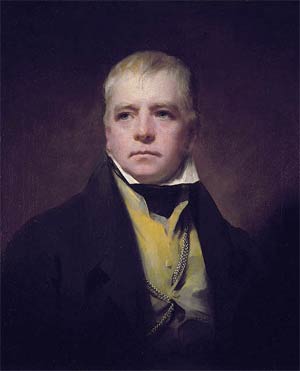
Scotsman, Sir Walter Scott, was a writer internationally famous within his own lifetime, especially for novels such as ‘Ivanhoe’ and ’Rob Roy’.
Scott, Sir Walter – 1st Baronet (1771-1832) – Sir Walter Scott was born in Edinburgh and, among many novels, he was the creator of ‘Ivanhoe’ (1819) and ‘Rob Roy’ (1817). The fascinating journal of this celebrated writer is an important record of the times in which he lived. As a writer of historical fiction, a playwright, and a poet, Scott was the first English language author to have a truly international career in his own lifetime, with many contemporary readers in Europe, Australia, and North America. Saint David Lodge No. 36 in Edinburgh was Sir Walter Scott’s lodge.
Sciubba, Elvio (1915-2001) – Sciubba was a 33rd Degree Freemason and Chief Controller of the Italian Treasury Department.
Seddon, Richard John (1845-1906) – Originally born in Eccleston, St. Helens, Lancashire, England, Richard Seddon eventually became the longest serving Prime Minister of New Zealand and is regarded by some as being one of its greatest leaders (1893–1906). A dedicated Mason, Seddon served as Grand Master of New Zealand (1898–1900).
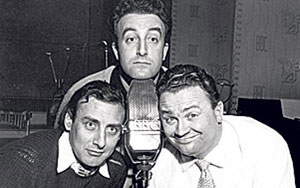
Together with Spike Milligan and Harry Secombe, Peter Sellers centre created a stellar pioneering comedy series, The Goon Show.
Sellers, Richard Henry ‘Peter’ (1925-1980) – An exceptional, internationally renowned, comedian and actor, Peter Sellers was a star of ‘The Goon Show’ alongside Spike Milligan and Harry Secombe. Sellars also portrayed the hilariously incompetent Inspector Clouseau in ‘The Pink Panther’ film series. In 1980 he received an Oscar® nomination for the film ‘Being There’, this was Sellers’ third Oscar® nomination. Peter Sellers attended Chelsea Lodge No. 3098 of the United Grand Lodge of England.
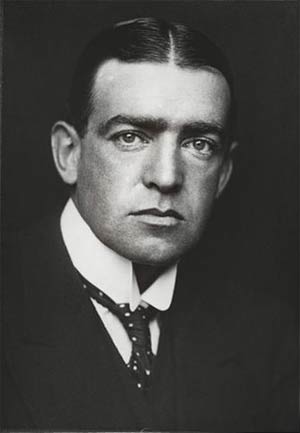
Irish explorer, Ernest Shackleton was one of the principle figures during period known as the Heroic Age of Antarctic Exploration.
Shackleton, Sir Ernest Henry (1874-1922) – This Irish-born explorer was one of the principle figures during the period of Antarctic exploration with his first major mission departing from Lyttelton Harbour, New Zealand in 1908. He went on to discover the magnetic south pole. His health was suspect and he died on his last expedition, he was buried on South Georgia.
Shackleton, Leonard Francis ‘Len’ (1922-2000) – Shackleton was an English foot- baller of the post-World War II period. His skill on the ball was such that he could tease the opposition while pleasing the crowd at the same time, as a result he became known as the ‘Clown Prince of Football’ and is generally regarded as one of English football’s finest ever entertainers.
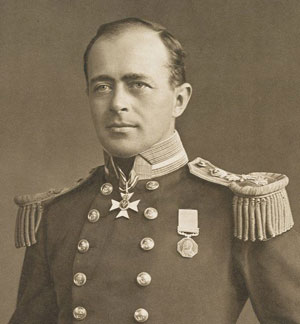
Scott of the Antarctic – There is a monument to this famous British explorer that overlooks Port Chalmers Harbour, Dunedin, NZ.
Scott, Robert Falcon – Captain, R.N. (1868-1912) – Captain Scott was an English Royal Navy officer and explorer who led two expeditions to the Antarctic regions: the Discovery Expedition (1901–04), and the ill-fated Terra Nova Expedition (1910–13). At a stage in this second venture, Scott led a party of five which reached the South Pole on 17 January 1912, only to find that they had been beaten to the prize by a Norwegian expedition led by Roald Amundsen. On their return journey, Scott and his four demor- alized comrades all perished from a combination of exhaustion, starvation and extreme cold. It was not until the support vessel Terra Nova reached Oamaru, New Zealand on the 10th February 1913, that news of their deaths became worldwide knowledge. (Related: see Ellison-Macartney above.)
Service, Robert William (1874-1958) – Born in Preston in the English County of Lancashire of Scottish parents, Robert Service actually made his name as a Canadian poet, after emigrating there in 1895. He was called ‘The Bard of the Yukon’ because of his writings about the Canadian north, and among his works are ‘The Cremation of Sam McGee’, ‘The Shooting of Dan McGrew’ and ‘The Spell of the Yukon.’ Service wrote ‘escapism’ poetry set in locales as distant as Afghanistan and New Zealand.
Sheridan, Richard Brinsley (1751-1816) – Born in Dublin, Ireland, Richard Sheridan was a playwright, poet and statesman and, from 1776, the owner of The Theatre Royal, Drury Lane, London. His most famous play is ‘The School for Scandal’ (1777). He served as a Whig in parliament for 32 years and was such was his esteem that, when he died, he was buried in Westminster Abbey.
Sibelius, Johan Julius Christian ‘Jean’ (1865-1957) – Having joined Suomi Lodge No.1, Helsinki, Finland, Brother Sibelius (the composer of ‘Finlandia’), wrote several pieces of interest to Masons including ‘Praising Hymn’ and the ‘Ode to Fraternity.’ Indeed, Sibelius composed Masonic ritual music covering all degree work in Craft Lodges, such as Opus 113, Musique Religieuse, which is the only complete ritual music for organs.
Sloan, James – In 1796 in County Armagh, Ireland, James Sloan co-founded the Orange Order (also known as The Orange Lodge), a fraternal Irish Protestant organisation. This institution was loyal to the Dutch protestant Prince William of Orange, who became King William III of England in 1689. It was strongly anti-nationalist.
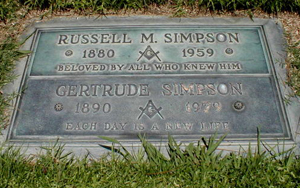
Actor Russell Simpson’s Masonically engraved gravestone.
Simpson, Russell McCaskill (1880-1959) – Russell Simpson was a prolific American character actor who enjoyed a 45 year long career spanning 1914 to 1959. He first appeared in fellow Freemason Cecil B. DeMille’s silent film ‘The Virginian’ in 1914 but Simpson is probably most known for his role